

The artist has given the complete sum of his £25k award winnings to the MVT, which works to protect the United Kingdom's independent live music spots.
The star was awarded the prize on 16 October as his new release the album was declared the top album of the last 12 months.
Fender has chosen to hand the money over to the Music Venues Trust, in appreciation of the crucial part small stages had in his initial steps.
"As an artist would not have achieved my current career if it weren't for all the performances I played around the region, and beyond, when I was starting out," remarked Fender. "These spaces are legendary, but they are facing challenges."
From early 2023 onward, over 150 of these spaces have ceased operations – about 16 percent of the whole industry in the UK.
Recently, major artists like the band Pulp, the group Coldplay, Katy Perry and Sheeran have all aided the MVT in its attempts to support the industry, by applying a modest fee to their ticket prices, which goes to help smaller concert halls.
Fender also joined in, generating in excess of £100,000 on his 2024 arena tour to support thirty-eight small stages across the UK.
The donation supported spaces that were dealing with possible closure due to difficulties arising from water damage, blazes and personal losses, as well as licensing issues, court cases and sound issues.
Some locations were granted funding support in modernizing amenities and technical equipment that helped musicians and concertgoers.
"The notion that funds from shows in large arenas backs the independent spots, where it all starts for performers like me, is just common sense," Fender has stated.
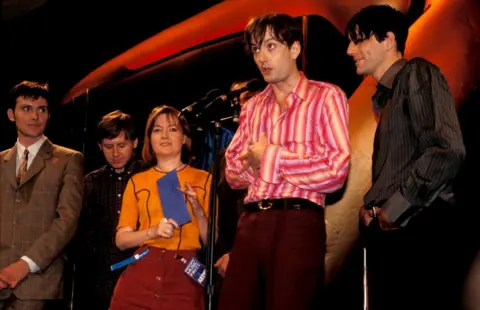
Fender is far from the only musician to donate his Mercury Prize prize money to charitable organizations.
Back when Pulp won the trophy in the year 1996 for their record the album, vocalist Jarvis Cocker stated that the act would give their cash to the non-profit War Child.
During 2002, artist Ms Dynamite divided her prize among multiple organizations, such as the NSPCC and a charity for Sickle Cell.
"I also donated a £1,000 to Highgate Newtown, to their classes, because I practiced gymnastics when I was growing up and they needed new equipment," the artist told outlets.
In recent years, they gave their prize money to the community center that supported their act, alongside other independent music bodies.
Additionally the 1994 recipients they contributed their award to a multiple sclerosis charity after a friend was identified with the disease.
"Winning was sufficient," remarked singer Small. "The money was the cherry on top but we didn't require the cherry, because we had the main prize. So our success touched somebody else's life."
In the past week, the trust announced it had rescued several small stages in south-east England, by transferring them to community ownership.
The first in Southampton and the second in the city were bought under the public acquisition initiative, which is funded by a national body and music fans who acquire "ownership units" in the buildings.

